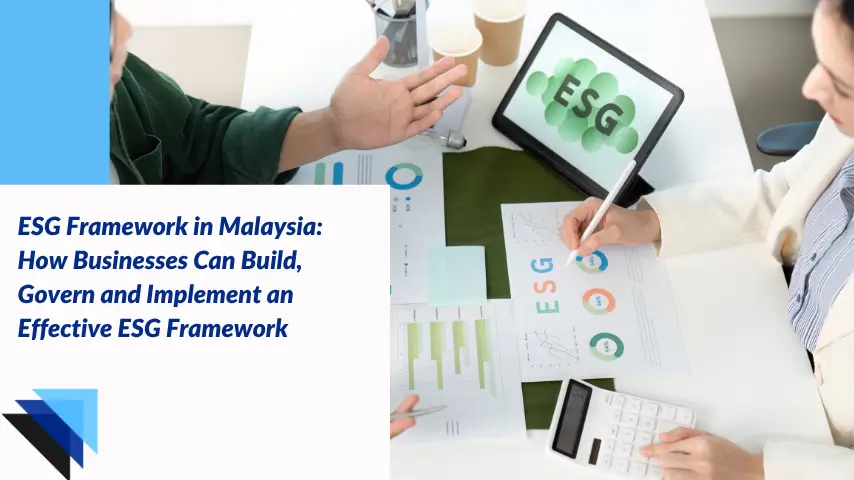
An ESG framework is a structured set of principles, categories, and metrics that helps an organization manage and report environmental, social, and governance performance in a consistent way. Rather than a single document or checklist, it functions as the organizing logic that connects strategy, data collection, and disclosure into one coherent system.
In Malaysia, the adoption of structured ESG framework and sustainability-management practices has accelerated through several overlapping regulatory developments. Bursa Malaysia’s Listing Requirements govern sustainability reporting by Main Market and ACE Market issuers, while the Securities Commission Malaysia’s National Sustainability Reporting Framework establishes Malaysia’s phased adoption of IFRS S1 and IFRS S2. Separately, Bank Negara Malaysia’s Climate Risk Management and Scenario Analysis policy sets climate-risk management and scenario-analysis requirements for regulated financial institutions. Bursa’s requirements apply to listed issuers, the NSRF implementation roadmap covers Main Market issuers, ACE Market issuers and large non-listed companies with annual revenue of RM2 billion and above, and BNM’s climate-risk expectations apply to regulated financial institutions, so coverage varies by company type rather than applying uniformly across the board. Yet many businesses still treat ESG primarily as a reporting exercise rather than a governed system, which is where a well-built ESG framework can change the outcome.
This guide covers what an ESG framework actually is and where the concept originated, its three core pillars, real-world ESG framework examples, how to choose and develop the right framework, the difference between frameworks and standards, common challenges Malaysian companies face, and how ESG ratings and audits fit into the picture.
Move Beyond ESG Reporting
An effective ESG framework helps organizations connect sustainability goals, governance structures, data management, and reporting into one practical system.
- What Exactly Is an ESG Framework?
- Which Are the Three Pillars of the ESG Framework?
- What Is an Example of an ESG Framework?
- How to Choose the Right ESG Framework?
- What Are the Five Steps to Introduce an ESG Framework?
- What Challenges Do Malaysian Companies Face in ESG?
- How Do ESG Ratings and Audits Work in Malaysia?
- How Can Wellkinetics Help
- References
What Exactly Is an ESG Framework?
An ESG framework is the structural blueprint an organization uses to identify, measure, manage, and report its environmental, social, and governance performance in a consistent, comparable way.
What Is the ESG Framework Meaning in Practical Terms?
In practical terms, the ESG framework meaning boils down to three connected functions: defining which topics matter (materiality), specifying how to measure them (metrics and indicators), and setting out how results get communicated (disclosure format). Without all three functions working together, an organization can end up with disconnected sustainability initiatives and a report that does not fully reflect how the business is managed.
A useful way to picture this is that a framework is the skeleton, while specific policies, targets, and reports are the tissue built onto it. Organizations that skip the framework and jump straight to writing a sustainability report often produce disclosures that are inconsistent year to year and harder for investors to benchmark.
RELATED: Sustainability Frameworks: A Guide to Global Standards and Their Application in Malaysia
What Is the Difference Between ESG Frameworks and Standards?
Frameworks, standards, regulatory requirements and internal management systems serve related but different purposes. A company’s internal ESG framework establishes how ESG matters are governed, assessed, measured and managed. Reporting standards such as the GRI Standards, IFRS S1 and IFRS S2 contain defined disclosure requirements or guidance. Regulatory instruments, including Bursa Malaysia’s Listing Requirements and Bank Negara Malaysia’s policy documents, determine which requirements apply to covered organizations.
The TCFD recommendations historically provided a four-part climate-disclosure architecture covering governance, strategy, risk management, and metrics and targets. The TCFD was disbanded in October 2023 after completing its work, and its architecture was incorporated substantially into the ISSB Standards. It should therefore be presented as a foundational disclosure architecture rather than as a current standalone standard-setting body.
In practice, many organizations use a framework to decide what matters and a standard to decide exactly how to measure and report it, which is why a company might describe itself as following the TCFD framework while reporting metrics in line with GRI Standards. Confusing the two is a common early mistake when building an ESG program, often resulting in documents that lack metric-level specificity.
Which Are the Three Pillars of the ESG Framework?
ESG framework is commonly organized around three pillars: Environmental, Social, and Governance, each addressing a distinct category of organizational impact and risk.
What Does the Environmental Pillar Cover?
The Environmental pillar addresses how an organization interacts with the natural world, including greenhouse gas emissions across Scope 1, 2, and 3, energy and water consumption, waste management, and biodiversity impact. For Malaysian companies in palm oil, manufacturing, and energy, this pillar is often highly material and closely scrutinized, especially where climate, land-use, and supply-chain impacts are significant.
What Does the Social Pillar Cover?
The Social pillar addresses how an organization treats people, spanning employees, supply chain workers, customers, and the communities in which it operates. Core areas include labor rights, workplace safety, diversity and inclusion, and community engagement. In Malaysia’s manufacturing and plantation sectors, foreign worker treatment and supply-chain labor practices are among the most scrutinized elements of this pillar by international customers and financiers.
What Does the Governance Pillar Cover?
The Governance pillar addresses the internal structures and controls that determine whether the other two pillars are managed with integrity, including board composition and independence, executive accountability, anti-corruption controls, and risk oversight. Governance is frequently underweighted relative to Environmental and Social in casual ESG discussions, yet it is the pillar that determines whether commitments made under the other two are actually implemented or simply aspirational.
RELATED: ESG: Regulatory Framework, Corporate Adoption, and Opportunities for SMEs in Malaysia
What Is the ESG Governance Framework Specifically?
The ESG governance framework refers to the specific structures, roles, and processes an organization puts in place to oversee its ESG program, distinct from the broader Governance pillar which covers corporate governance generally. This typically includes a board-level committee or mandate for sustainability oversight, a named executive with accountability for ESG performance, and defined reporting lines between sustainability, finance, and operations teams.
Bursa Malaysia’s sustainability reporting requirements and governance expectations make board-level ESG oversight an important expectation for listed issuers, not just a best-practice enhancement.
What Is an Example of an ESG Framework?
Several established ESG frameworks and standards are in active use globally and in Malaysia, each suited to different reporting priorities and audiences.
What Are Common ESG Framework Examples Used by Malaysian Companies?
Common ESG reporting references in Malaysia include GRI Standards for broad stakeholder-facing reporting, IFRS S1 and IFRS S2 for investor-focused sustainability-related financial disclosures, SASB standards for investor-focused, industry-specific metrics. Bursa Malaysia issued amendments to its sustainability reporting requirements in December 2024 to support the phased implementation of IFRS S1 and IFRS S2. The applicable commencement period differs according to the category of listed issuer and the transitional reliefs available under the NSRF. Together, these developments move Malaysia toward IFRS S1/S2-aligned sustainability reporting.
What Is the Most Widely Used ESG Framework Globally?
GRI Standards remain one of the most widely used sustainability reporting frameworks and standards globally. GRI’s broad, stakeholder-inclusive approach explains its reach: it addresses the full range of ESG topics rather than focusing narrowly on climate or investor materiality, making it applicable across almost any sector or organization size.
However, “widely used” does not mean “most appropriate for every purpose.” IFRS S1 and S2 standards from the International Sustainability Standards Board are gaining ground specifically because investors want climate and financially material sustainability data in a more standardized, comparable format than GRI’s broader approach provides.
How to Choose the Right ESG Framework?
Choosing an ESG framework is a decision that should follow from an organization’s regulatory obligations, primary stakeholder audience, and sector, not from which framework is most talked about.
How to Choose the Right ESG Framework for a Specific Organization?
Organizations should first identify the regulatory mandates that apply to them. Under the NSRF implementation roadmap, Group 1 comprises Main Market issuers with market capitalisation of RM2 billion and above and begins applying the ISSB Standards for annual reporting periods beginning on or after 1 January 2025. Group 2, comprising other Main Market issuers, begins on or after 1 January 2026. Group 3, comprising ACE Market issuers and large non-listed companies with annual revenue of RM2 billion and above, begins on or after 1 January 2027. Regulated financial institutions may also have separate climate-risk obligations outside this phased schedule. Second, organizations should identify their primary audience: investors typically want SASB or IFRS S1/S2-style financially material metrics, while broader stakeholders including employees, communities, and NGOs respond better to GRI’s inclusive structure.
Sector also matters significantly. A financial institution’s material ESG topics differ substantially from a palm oil producer’s, which is why SASB’s industry-specific standards exist in the first place. Choosing a generic framework without sector-specific adaptation often results in reporting that technically complies but fails to address the topics stakeholders actually care about.
Can Organizations Use More Than One ESG Framework at Once?
Yes, and in practice many larger organizations do. It is common to layer frameworks, using GRI for comprehensive stakeholder disclosure and IFRS S1/S2 to disclose sustainability-related risks and opportunities that could affect its prospects, rather than treating framework selection as an exclusive choice. The challenge is not selecting one framework but avoiding duplicated data collection efforts across frameworks that ask similar questions in different formats.
Need Help Selecting the Right ESG Framework?
Choosing between GRI, TCFD, SASB, and IFRS S1/S2 requires understanding your regulatory obligations, industry risks, and stakeholder expectations.
What Are the Five Steps to Introduce an ESG Framework?
Introducing an ESG framework often follows a broadly consistent five-step sequence, regardless of which specific framework or combination of frameworks an organization ultimately adopts. This reflects a practical implementation approach rather than a prescribed regulatory sequence.
1. Step One: Materiality Assessment
A practical implementation process generally begins with materiality assessment, identifying which ESG topics are significant to the business and to its stakeholders through structured engagement rather than internal assumption. This step determines what the framework will actually need to cover, making it the foundation every subsequent step depends on.
2. Step Two: Governance Structure Design
The second step establishes the ESG governance framework, assigning board oversight, executive accountability, and cross-functional coordination before data collection begins. Skipping this step is a common mistake, since organizations that start collecting data before establishing ownership often find no one is accountable when data quality issues surface later.
3. Step Three: Framework and Metric Selection
The third step selects the specific framework or combination of frameworks and standards, based on regulatory requirements, audience, and sector, as outlined above, and defines the specific metrics that will be tracked under each material topic identified in step one.
4. Step Four: Data Infrastructure and Baseline Establishment
The fourth step builds the systems needed to collect, verify, and store ESG data reliably, and establishes a baseline year against which future performance will be measured. Many companies underestimate this step, treating data collection as an annual scramble rather than an ongoing management process, which can produce inconsistent year-on-year figures and weaken credibility.
5. Step Five: Reporting, Assurance, and Continuous Improvement
The fifth step produces the actual disclosure, considers whether external assurance is needed to enhance credibility, and feeds performance results back into strategy and target-setting for the following cycle. An ESG framework that stops at step five’s reporting stage without feeding back into strategy is functioning as a compliance exercise rather than a management system.
Strengthen Your ESG Governance Structure
A successful ESG framework requires clear accountability, defined roles, and governance processes that connect sustainability goals with business decision-making.
What Challenges Do Malaysian Companies Face in ESG?
Malaysian companies implementing ESG frameworks often encounter practical obstacles, many of which stem from resource constraints and data-maturity gaps rather than lack of intent.
What Data and Resource Challenges Are Most Common?
One of the most common challenges is data availability, particularly Scope 3 emissions and supply chain labor data, since Malaysian supply chains include large numbers of small and medium suppliers that lack the systems to report granular ESG data. Smaller Malaysian listed companies may also lack dedicated sustainability staff, leaving ESG framework implementation as an additional responsibility for finance or HR teams already stretched across other priorities.
What Governance and Capability Challenges Persist?
A second recurring challenge is superficial governance, where a sustainability committee exists on paper but lacks real authority or budget, undermining the credibility of the entire ESG governance framework. This is compounded by a shortage of professionals with hands-on ESG framework implementation experience in the Malaysian market, leading many companies to rely on external consultants while building in-house capability over time.
Overcome ESG Implementation Challenges
From data collection gaps to limited internal capabilities, practical ESG implementation requires the right systems, processes, and expertise.
How Do ESG Ratings and Audits Work in Malaysia?
ESG ratings and audits serve different external-check functions: ratings are external assessments, while audits or assurance engagements verify whether ESG data and disclosures hold up to independent scrutiny.
How Do ESG Ratings in Malaysia Work?
Malaysian listed companies may be assessed by international ESG rating and research providers such as MSCI ESG Ratings and Sustainalytics. which assess listed companies against their own proprietary methodologies, and by local benchmarks including the FTSE4Good Bursa Malaysia Index, an ESG-screened index rather than a rating agency, which evaluates constituent companies against methodology-based ESG criteria specific to the Malaysian market. These ratings can matter commercially because some institutional investors use them in screening and risk assessment, which can affect capital access.
Because rating methodologies vary and are not always fully transparent, a common frustration among Malaysian companies is receiving different scores from different agencies despite reporting the same underlying data. This is generally a product of differing weightings and proprietary adjustments rather than evidence that either rating is wrong.
What is ESG Assurance?
An ESG assurance engagement is an independent examination of specified sustainability information against defined reporting criteria. It is distinct from an ESG rating, which represents an assessment produced under a rating provider’s methodology rather than independent assurance over the organization’s reported information.
ESG assurance procedures may examine source records, calculation methodologies, reporting boundaries, estimation techniques, data controls and management review processes. Limited assurance involves less extensive procedures and results in a negative-form conclusion, while reasonable assurance involves more extensive evidence-gathering and results in a positive-form conclusion. The precise procedures depend on the subject matter and assurance standard applied.
How Can Wellkinetics Help
Wellkinetics supports Malaysian organizations in building, governing, and implementing ESG frameworks that satisfy regulatory requirements while functioning as genuine management systems rather than reporting exercises:
1. ESG Framework Selection and Design: Assessment of regulatory obligations, stakeholder audience, and sector-specific requirements to identify the right combination of frameworks and standards, including GRI, SASB, and IFRS S1/S2 alignment with the NSRF.
2. ESG Governance Framework Development: Design of board oversight structures, executive accountability assignments, and cross-functional coordination mechanisms that give the ESG framework real organizational authority rather than nominal sponsorship.
3. Materiality Assessment and Data Infrastructure: Facilitation of structured stakeholder engagement to identify material topics, and design of data collection systems and baseline establishment processes that produce reliable, year-on-year comparable metrics.
4. ESG Policy and Documentation: Drafting of ESG policy documents, governance charters, and internal procedures that translate the framework into practical guidance for staff and suppliers.
5. ESG Audit and Assurance Readiness: Preparation of data sources, calculation methodologies, and internal controls to withstand external assurance review, and support in selecting appropriate assurance levels and providers in line with NSRF phased assurance expectations.
6. ESG Rating Improvement Support: Analysis of rating agency methodologies including MSCI ESG Ratings and Sustainalytics to identify specific gaps between current disclosure and rating criteria, and targeted improvement planning.
7. Ongoing ESG Services: Continuous improvement support including regulatory monitoring, benchmark studies against industry peers, and periodic framework reviews ensuring the ESG framework evolves alongside changing requirements and business context.
By partnering with Wellkinetics, Malaysian organizations gain a structured, practical path to building an ESG framework that holds up to regulatory scrutiny, investor evaluation, and genuine operational implementation.
Learn more about our ESG Consultancy services.
References
- Bursa Malaysia. Sustainability Reporting Requirements. Kuala Lumpur: Bursa Malaysia.
- Securities Commission Malaysia. National Sustainability Reporting Framework (NSRF). Kuala Lumpur: SC Malaysia.
- United Nations Global Compact. (2004). Who Cares Wins: Connecting Financial Markets to a Changing World. New York: UN Global Compact.
- Principles for Responsible Investment. PRI Overview and History. London: PRI Association.
- Global Reporting Initiative. GRI Standards Documentation. Amsterdam: GRI.
- Task Force on Climate-related Financial Disclosures. TCFD Recommendations. Basel: Financial Stability Board.
- International Sustainability Standards Board. (2023). IFRS S1 and IFRS S2. London: IFRS Foundation.
Further Reading
International Frameworks and Standards:
- Global Reporting Initiative (GRI) – www.globalreporting.org
- TCFD Recommendations – www.fsb-tcfd.org
- ISSB (IFRS S1/S2) – www.ifrs.org/groups/international-sustainability-standards-board/
- Sustainability Accounting Standards Board (SASB) – www.ifrs.org/issued-standards/sasb-standards/
Malaysian Regulatory Resources:
- Bursa Malaysia Sustainability Reporting Requirements
- Securities Commission Malaysia National Sustainability Reporting Framework (NSRF)
- FTSE4Good Bursa Malaysia Index Methodology