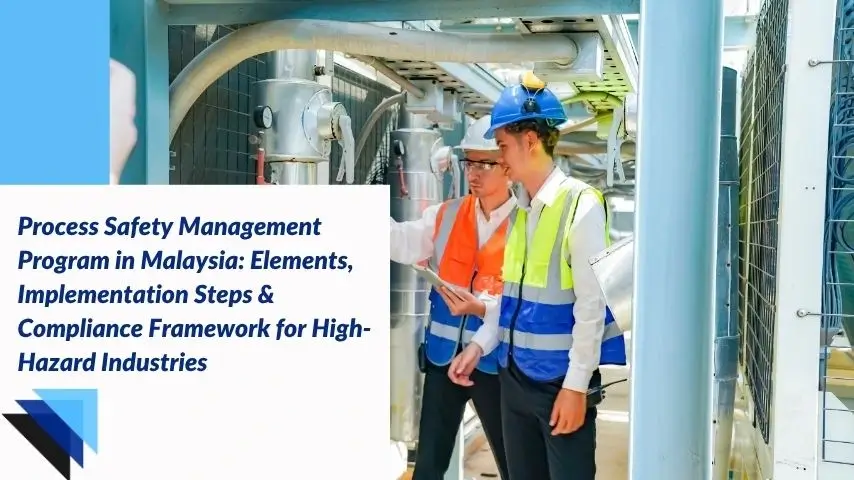
A Process Safety Management program is a comprehensive, systematic framework designed to prevent catastrophic incidents involving hazardous chemicals in industrial facilities. This structured approach identifies, evaluates, and controls process hazards that could lead to major accidents affecting workers, communities, and the environment.
In Malaysia, the Department of Occupational Safety and Health (DOSH) oversees Process Safety Management program compliance through the Occupational Safety and Health Act (OSHA) 1994. Malaysian industries nationwide must maintain comprehensive safety management systems.
This guide explores the OSHA Process Safety Management 14 elements, developing a process safety management plan, examining process safety management program examples, and establishing effective process safety management program policy foundations for Malaysian high-hazard industries.
Strengthen Your Process Safety Management Program
Identify gaps and improve your safety framework before incidents occur.
What is a Process Safety Management Program and Why Does It Matter?
A Process Safety Management program encompasses systematic approaches to identifying, understanding, and controlling hazards associated with processes involving highly hazardous chemicals. Understanding the fundamentals helps organizations prevent catastrophic incidents.
RELATED: The Importance of Process Safety in Handling Hazardous Substances
What Distinguishes Process Safety from Occupational Safety?
Process Safety Management programs originated from major industrial disasters including the 1984 Bhopal tragedy and the 1989 Phillips 66 explosion in Texas. These events demonstrated the need for systematic approaches beyond traditional occupational safety programs.
Occupational safety focuses on protecting individual workers from immediate hazards like slips, falls, and ergonomic issues. Process Safety Management programs address low-probability, high-consequence events that could result in major releases affecting entire facilities and communities. This distinction requires different management approaches emphasizing barrier integrity, systemic risk control, and organizational learning.
Why Must Malaysian Industries Implement PSM Programs?
Malaysian regulations require Process Safety Management program implementation in facilities handling hazardous materials above threshold quantities. Beyond compliance, major process safety events cost organizations tens of millions in direct losses, business interruption, legal liabilities, and reputational damage.
Organizations viewing Process Safety Management programs as strategic assets achieve superior safety performance while building resilient operations. Preventing major incidents protects workforce safety, maintains community trust, ensures regulatory compliance, and sustains corporate reputation.
How Do PSM Programs Prevent Major Incidents?
Process Safety Management programs prevent catastrophic incidents through defense-in-depth: multiple, independent protection layers working together to control hazards. This approach recognizes that individual safeguards occasionally fail, requiring redundant barriers.
The hierarchy of controls prioritizes inherently safer design approaches that eliminate or minimize hazards at source. Substituting less hazardous materials, reducing dangerous substance inventories, moderating process conditions, and simplifying processes represent inherent safety strategies. When inherent safety proves insufficient, engineering controls including pressure relief systems, emergency shutdown systems, and containment provide additional protection.
Administrative controls constitute critical Process Safety Management program elements but depend on human performance. Operating procedures, training programs, permit-to-work systems, and management of change processes ensure personnel understand hazards and execute tasks safely. Effective programs combine administrative controls with robust engineering barriers and inherent safety measures.
What Are the OSHA Process Safety Management 14 Elements?
The Process Safety Management 14 elements represent foundational building blocks of comprehensive safety management systems as defined by OSHA’s PSM standard. These elements provide complete coverage of critical safety functions across hazard identification, operational control, and organizational learning.
Which Elements Address Process Knowledge and Hazard Assessment?
Process Safety Information requires comprehensive documentation of hazardous chemical properties, process technology information, and equipment design specifications. This information must be accurate, complete, accessible, and regularly updated. Malaysian facilities should maintain process safety information in formats and languages appropriate for diverse workforces.
Process Hazard Analysis represents systematic evaluation of scenarios that could lead to releases of hazardous materials. The Process Safety Management program requires facilities to conduct analyses using methodologies including HAZOP, What-If analysis, or Checklist analysis. According to DOSH guidance, teams must include personnel with expertise in engineering, operations, and the specific process.
Hazard analyses must identify hazards, evaluate consequences, assess safeguards, and generate recommendations. Organizations must address recommendations by implementing them or documenting management decisions to accept risks with alternative safeguards. Malaysian facilities typically conduct initial analyses when establishing programs, then update every five years or following significant modifications.
Pre-Startup Safety Review verifies that new or modified facilities meet design specifications, safety equipment is installed and tested, operating procedures are in place, and training is complete before operations begin.
Which Elements Govern Operations and Maintenance?
Operating Procedures provide detailed, written instructions for safely conducting activities involving hazardous chemicals during normal operations, startup, shutdown, emergency operations, and temporary operations. Effective procedures address steps for conducting activities, operating limits, safety considerations, safety systems and their functions, and special hazards.
Employee Participation ensures workforce involvement in Process Safety Management program development and implementation. Workers possess valuable knowledge about operational practices, equipment performance, and near-misses that inform hazard analyses, procedure development, and incident investigations.
Training ensures employees understand operating procedures, process hazards, emergency response, and safe work practices. The Process Safety Management 14 elements require initial training, refresher training, and documentation of training completion and competency.
Contractors must be evaluated, informed of hazards, and trained on safe work practices. The facility must ensure contractor employees receive appropriate training and maintain injury/illness logs.
Mechanical Integrity addresses systematic programs for maintaining critical process equipment including pressure vessels, storage tanks, piping systems, relief systems, emergency shutdown systems, and process controls. Programs require written inspection and testing procedures, appropriate frequencies, qualified personnel, and deficiency correction before equipment returns to service.
Which Elements Address Change Management and Emergency Response?
Management of Change ensures systematic review of proposed modifications before implementation, preventing inadvertent introduction of new hazards. The Process Safety Management program requires written procedures for managing changes to process chemicals, technology, equipment, procedures, and facilities.
Changes must be reviewed by qualified personnel, necessary updates to process safety information and operating procedures must be completed, and affected employees must be informed and trained before changes are implemented.
Emergency Planning and Response prepares facilities to respond effectively when incidents occur. Requirements include emergency action plans addressing potential scenarios, procedures for emergency response, emergency equipment specifications, and training for responders. Malaysian facilities coordinate planning with local fire departments, civil defense authorities, and community organizations.
Incident Investigation requires promptly investigating incidents that resulted in or could reasonably have resulted in catastrophic releases. Investigations must be initiated promptly, conducted by knowledgeable teams, and documented with findings and recommendations tracked through resolution.
Which Elements Ensure Compliance and Documentation?
Compliance Audits require facilities to certify at least every three years that they have evaluated compliance with Process Safety Management program requirements. Audits must be conducted by knowledgeable personnel, employ appropriate procedures, and generate reports documenting findings.
Recordkeeping ensures proper documentation and retention of Process Safety Management program records including process safety information, hazard analyses, training records, inspection and testing results, incident investigations, and audit reports. Proper recordkeeping demonstrates regulatory compliance and supports continuous improvement.
Trade Secret Protection addresses how facilities protect confidential information while ensuring employees and contractors receive necessary process safety information to perform their jobs safely.
Need Support Implementing the OSHA PSM 14 Elements?
Get expert guidance to build a structured and compliant process safety system.
How Should Organizations Develop a Process Safety Management Plan?
Developing an effective process safety management plan requires systematic approaches addressing regulatory requirements, organizational contexts, and practical implementation challenges.
What Are the Essential Planning Steps?
Planning begins with comprehensive gap assessment comparing current programs against all Process Safety Management 14 elements. This identifies strengths, gaps requiring attention, and priorities based on risk levels and resource availability. Organizations new to Process Safety Management programs benefit from external expertise, while facilities with existing programs may conduct self-assessments.
Leadership commitment represents the essential foundation. Senior management must understand requirements, commit necessary resources, and demonstrate that process safety is valued alongside production objectives. Without authentic leadership commitment, planning efforts struggle to overcome competing priorities.
Following gap assessment and leadership alignment, organizations develop phased implementation plans addressing critical gaps first while building momentum. Attempting to implement all Process Safety Management 14 elements simultaneously often overwhelms organizations. Focused, sequential approaches allow capability building and learning. Typical implementation timelines span 18-36 months for foundational programs.
How Can Organizations Integrate PSM Elements?
Successful process safety management plans recognize interdependencies among the Process Safety Management 14 elements. Effective Operating Procedures depend on accurate Process Safety Information, adequate Training, proper Management of Change, and Mechanical Integrity ensuring equipment operates as procedures assume.
Organizations design integrated systems where documentation, processes, and responsibilities connect logically across elements. This reduces duplication, ensures consistency, and helps personnel understand how their work contributes to overall process safety. Modern software platforms facilitate integration through centralized repositories, automated workflows, and dashboards aggregating performance metrics.
The process safety management plan should explicitly address how elements will be integrated, specifying common documentation systems, shared governance structures, coordinated training programs, and unified performance measurement frameworks.
What Resources Does PSM Planning Require?
Resource requirements vary based on facility complexity, existing program maturity, and organizational capabilities. However, all process safety management plans must address personnel with appropriate technical competencies, time for employees to participate in hazard analyses and PSM activities, funding for equipment upgrades, training, and software systems, and management attention to prioritize safety.
Personnel competency proves particularly critical, as Process Safety Management 14 elements require expertise in chemical engineering, process operations, equipment inspection, and safety management systems. Smaller Malaysian facilities may lack internal expertise, necessitating shared services with sister facilities, industry consortium approaches, or strategic use of consultants.
The process safety management plan should include realistic resource estimates and funding commitments. Organizations should view Process Safety Management program investments as risk management, considering potential losses from major incidents against resources required for effective prevention.
How Can Wellkinetics Help
A robust Process Safety Management program is crucial for businesses with manufacturing plants to protect lives and the environment, as well as safeguard business assets and reputation. Wellkinetics has in-house capabilities to review and propose improvements to your company’s PSM program, leveraging best practices and global guidelines.
Our support ranges from a concise ‘Pathfinder’ or gap review exercise to a full-blown PSM roll-out program for your company, an independent assurance activity, or a deep dive into specific areas of interest. We can also support, facilitate, or undertake technical safety studies tailored to your operational needs.
Examples of solutions we provide:
- PSM Program Roll-out: Provision of consultation and implementation support for the comprehensive roll-out of Process Safety Management programs aligned with DOSH requirements and international standards.
- PSM Audits and Health Checks: Provision of audit and health check services for existing PSM programs, specific Process Safety elements, or procedures to identify gaps and improvement opportunities.
- Enhancement Proposals: Provision of enhancement proposals for existing PSM programs, specific Process Safety elements, or procedures based on industry best practices and regulatory expectations.
- Training and Competency Development: Provision of training sessions to enhance staff competency to deliver an effective PSM program across all 14 elements, from leadership to frontline personnel.
- Best Practice Benchmarking: Deep dive into specific Process Safety work processes or procedures and compare against industry best practices to identify performance gaps and improvement strategies.
- Process Safety Facilitation: Facilitate specific Process Safety sessions for operational or project purposes including HAZOP workshops, accident investigations, and management of change reviews.
- Technical Deliverables: Deliver specific Process Safety-related workscope including CIMAH reports, process hazard analyses, pre-startup safety reviews, and mechanical integrity assessments.
By partnering with Wellkinetics, Malaysian high-hazard industries gain trusted advisors with deep technical expertise, practical implementation experience, and commitment to developing sustainable internal capabilities enabling long-term Process Safety Management program success.
Learn more about our process safety management consulting services.
References and Further Reading
- Department of Occupational Safety and Health Malaysia. Occupational Safety and Health Act 1994. Putrajaya: DOSH.
- Department of Occupational Safety and Health Malaysia. Occupational Safety and Health (Use and Standards of Exposure of Chemicals Hazardous to Health) Regulations 2000. Putrajaya: DOSH.
- United States Occupational Safety and Health Administration. Process Safety Management of Highly Hazardous Chemicals Standard (29 CFR 1910.119). Washington, DC: OSHA.
- Center for Chemical Process Safety. Guidelines for Risk Based Process Safety. New York: American Institute of Chemical Engineers.