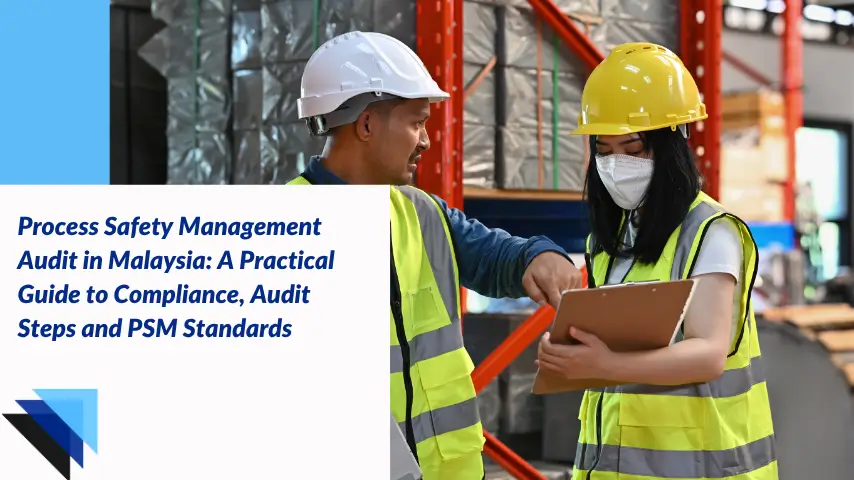
A Process Safety Management audit is a systematic evaluation that verifies whether a facility’s safety management system is functioning as designed and complying with applicable process safety management standards. Unlike routine internal inspections, a Process Safety Management audit tests the entire system, documentation, physical conditions, and workforce practices, against a defined compliance benchmark, producing findings that management is expected to act on.
In Malaysia, facilities that use chemicals hazardous to health must comply with USECHH duties on maintaining a register of chemicals hazardous to health, risk assessment, exposure control, monitoring, training, health surveillance, and recordkeeping, as reflected in DOSH’s USECHH guidance and summary materials, while many organizations also conduct process safety audits as part of their internal assurance or corporate governance programs. For petrochemical, refining, and chemical manufacturing operations concentrated in Gebeng, Pasir Gudang, and other industrial zones, the audit is an important mechanism for checking whether safety commitments on paper match conditions on the ground.
This guide covers what a process safety audit actually involves, the steps of a process safety audit, how audits are structured against process safety management standards, and how organizations can prepare for and act on audit findings.
Strengthen Your Process Safety Assurance
A structured Process Safety Management audit can help your organization evaluate current practices, identify gaps, and prioritize improvements.
What Is a Process Safety Audit?
A process safety audit is an independent, structured examination of whether a facility’s process safety management system meets defined requirements and functions effectively in practice, not just on paper.
What Is a Process Safety Audit Trying to Verify?
A process safety audit verifies three distinct things at once: that written programs exist for each required element, that those programs are actually being followed by personnel day to day, and that the combination of the two appears adequate to control major hazard risk. A facility can fail an audit on any one of these three dimensions even while passing the others, which is why audit teams are trained to look past polished documentation and test what is actually happening on the floor.
This distinguishes a process safety audit from a compliance checklist review. A checklist confirms a document exists; an audit confirms the document reflects reality, and that reality is adequate to control the hazard.
How Is a Process Safety Audit Different From a Process Hazard Analysis?
A process hazard analysis identifies what could go wrong in a specific process and what safeguards should exist. A process safety audit checks whether those safeguards, and the broader management system around them, actually exist and function as intended. The two are sequential rather than interchangeable: hazard analysis defines the standard a facility should meet, and the audit tests whether it is being met.
Confusing the two is a common early mistake. A facility that has conducted thorough hazard analyses but has never audited whether the resulting recommendations were implemented has only completed half the safety management cycle.
Why Do High-Hazard Facilities in Malaysia Often Conduct Process Safety Audits?
High-hazard facilities in Malaysia often conduct process safety audits because the consequences of an uncontrolled release extend well beyond the site boundary, affecting workers, neighboring communities, and the environment simultaneously. USECHH Regulations 2000 place responsibility on employers to identify hazardous chemicals, assess health risks, control exposure, monitor exposure where required, and maintain records, rather than relying on self-declaration alone; many facilities layer process safety audits on top of these baseline duties as a broader assurance mechanism covering the full safety management system rather than exposure control alone.
Beyond the regulatory driver, the financial case can be significant. Major process safety incidents can be costly in terms of business interruption, remediation, and legal exposure, often exceeding the cost of a rigorous audit program, which is why audits are increasingly used as a risk management tool rather than a reluctant compliance obligation.
ALSO READ: The Importance of Process Safety in Handling Hazardous Substances
Need to Assess Your Process Safety Management System?
Understand your current process safety strengths and identify areas that may require further review.
What Are the Steps of a Process Safety Audit?
A process safety audit follows a defined sequence of stages, each building on the findings of the one before it, from initial planning through final verification that corrective actions have closed identified gaps.
1. Step One: Audit Planning and Scoping
Audit planning establishes the scope, the specific standard or framework (e.g. 20 Element PSM Framework by CCPS or 14 Element PSM Framework by DOSH), the audit will be measured against, the audit team composition, and the schedule. This stage also involves reviewing prior audit reports, incident history, and any significant process changes since the last audit, since these inputs shape which areas warrant deeper scrutiny during the current cycle.
Scoping decisions made at this stage determine whether the audit will be comprehensive across all elements of process safety management or focused on specific areas flagged by previous findings or recent incidents. A facility that experienced a near-miss involving mechanical integrity, for example, would typically receive deeper audit attention on inspection and testing records than a facility with a clean recent history.
2. Step Two: Document Review
Document review examines process safety information, hazard analyses, operating procedures, training records, maintenance and inspection logs, and management of change records against the requirements of the applicable process safety management standards. Auditors typically sample records rather than reviewing every document, since full review of every record at a large facility is neither practical nor necessary to draw valid conclusions.
The sampling approach itself matters for audit credibility. A sample skewed toward recently updated, well-organized files will understate real gaps, so experienced auditors deliberately pull older records and records from less-visited areas of the facility to get a representative picture rather than the facility’s best-case files.
3. Step Three: Field Verification
Field verification involves physically walking the facility to confirm that conditions match what the documentation describes. This includes checking equipment condition, safety device functionality, labeling, housekeeping, and whether operators are following documented procedures rather than informal workarounds that have developed over time.
Field verification is where audits most often surface gaps that document review alone would miss, since a procedure can read correctly on paper while operators have quietly adapted their actual practice in response to equipment limitations, staffing pressures, or simply habit.
4. Step Four: Personnel Interviews
Interviews with operators, maintenance staff, supervisors, and safety personnel test whether the workforce understands hazards, procedures, and their own responsibilities, and often reveal gaps between what management believes is happening and what workers actually experience day to day. Skilled interviewers create conditions where personnel feel able to describe actual practice honestly, since defensive or scripted responses undermine the value of this stage significantly.
5. Step Five: Findings Development and Reporting
Findings are classified by severity, distinguishing conditions that pose immediate risk from lower-priority gaps that can be addressed over a longer timeline, and documented with enough specificity that facility personnel can act on them without needing further clarification from the audit team. The final report should also note where the facility is performing well, since a report that lists only deficiencies without acknowledging strong practices tends to generate defensiveness rather than constructive engagement from facility staff.
6. Step Six: Corrective Action and Follow-Up Verification
Corrective action planning assigns ownership, timelines, and resources to each finding, and follow-up verification confirms that corrective actions were actually completed and effective, not merely marked closed in a tracking system. This closing stage is where many audit programs lose momentum; findings are documented thoroughly but never verified as resolved, allowing the same gaps to reappear in the next audit cycle.
Planning a Process Safety Management Audit?
Get guidance on defining the audit scope, selecting suitable criteria, and preparing for an effective review.
How Are Audits Structured Against Process Safety Management Standards?
A process safety management compliance audit is only as meaningful as the standard it is measured against, which means selecting and applying the right reference framework is a foundational decision rather than a formality.
Which Process Safety Management Standards Are Commonly Used as Audit Criteria?
Many facilities structure process safety audits against the 14-element framework established by the United States Occupational Safety and Health Administration’s Process Safety Management standard (29 CFR 1910.119), and some organizations also adapt those elements to local corporate requirements and recognized best practice. These elements include Process Safety Information, Process Hazard Analysis, Operating Procedures, Training, Contractors, Mechanical Integrity, Management of Change, Emergency Planning and Response, Incident Investigation, Compliance Audits, and several others covering employee participation and documentation practices.
Facilities with international parent companies sometimes layer additional criteria from the Center for Chemical Process Safety’s Risk Based Process Safety guidelines on top of the 14-element structure, since CCPS guidance provides more granular maturity benchmarks within each element than the regulatory standard alone specifies.
How Often Should a Process Safety Management Compliance Audit Be Conducted?
A three-year compliance-audit cycle is a well-known benchmark in OSHA’s Process Safety Management standard and is often used as a reference point when structuring process safety audits, including by facilities in Malaysia that voluntarily align with this framework. However, this three-year interval represents a minimum floor rather than best practice; many higher-risk facilities and those with recent significant incidents conduct comprehensive audits annually, supplemented by focused audits on specific elements between full cycles.
Determining the right frequency for a specific facility should reflect actual risk profile rather than defaulting to a benchmark interval, since a facility handling larger inventories of more hazardous materials, or one with a history of findings that recur across audit cycles, carries a stronger case for more frequent review.
Who Should Conduct a Process Safety Audit?
Audit teams should include personnel with relevant technical expertise who are independent from the operations being audited, since auditors evaluating their own area of responsibility introduce an unavoidable conflict of interest regardless of their good intentions. Many facilities use a mix of internal auditors from other sites within the same company and external consultants, balancing internal process knowledge against the objectivity an outside party brings.
There is a reasonable debate about whether internal or external auditors produce more valuable results. Internal auditors bring deeper familiarity with the specific process and organizational context, while external auditors bring broader benchmarking experience across many facilities and less exposure to the internal politics that can soften findings. Most mature audit programs use both over a multi-year cycle rather than relying exclusively on one or the other.
What Common Challenges Affect Process Safety Audit Quality in Malaysia?
Even well-intentioned audit programs in Malaysia encounter recurring obstacles that can undermine the value of the exercise if not actively managed.
What Documentation and Data Challenges Are Most Common?
Facilities operating for decades often carry legacy documentation gaps, records that were never digitized, equipment histories with missing sections, or procedures that were updated informally without corresponding documentation changes. These gaps do not necessarily indicate poor safety performance, but they make it harder for an audit to draw confident conclusions, often forcing auditors to rely more heavily on field verification and interviews to compensate for documentation weaknesses.
What Workforce and Cultural Challenges Affect Audit Accuracy?
Malaysia’s multicultural, multilingual industrial workforce presents a genuine challenge for audit accuracy, since interviews conducted through translation or across significant language gaps can miss the nuance needed to detect whether a worker truly understands a hazard or is simply repeating a memorized answer. Audits that rely on a single language or a rushed interview schedule risk underestimating genuine gaps in workforce understanding.
What Organizational Pressures Undermine Audit Independence?
Production pressure and cost constraints can create quiet resistance to audit findings that would require capital expenditure or operational slowdowns to address, particularly at facilities where audit teams report through operational management rather than an independent safety function. This is not unique to Malaysia, but it is worth naming directly: an audit’s value depends heavily on whether the organization has a genuine appetite to act on uncomfortable findings, not just document them.
How Can Wellkinetics Help
Wellkinetics supports Malaysian facilities in planning, conducting, and acting on process safety management audits that meet recognized process safety standards while genuinely strengthening safety performance:
1. Process Safety Management Compliance Audit Execution: Independent audit delivery against the 14-element PSM Framework by OSHA or the 20-Element PSM Framework by CCPS Risk Based Process Safety guidance including document review, field verification, and personnel interviews conducted by auditors with relevant technical expertise and no operational conflict of interest. This includes a PSM Audit Report preparation which covers classification of findings by severity, development of specific and actionable recommendations.
2. PSM Program Roll-Out: Support for facilities building or maturing an internal audit capability, including auditor training, protocol development, and internal-external audit cycle design.
3. Provision of audit and health check of existing PSM Program, a specific Process Safety Element or Procedure.
4. Provision of enhancement proposal of existing PSM Program, a specific Process Safety Element or Procedure
5. Provision of training sessions to enhance the competency of staff to deliver an effective PSM Program
6. Deep dive into specific Process Safety Work Process or Procedure and compare vs industry best practices
7. Facilitate Specific Process Safety Sessions for operational or project purposes (e.g. HAZOP workshops, Accident Investigation)
By partnering with Wellkinetics, Malaysian facilities gain an independent, technically credible perspective on process safety management audit practice, one that identifies genuine gaps and supports their resolution rather than simply producing a report to file away.
References
- Department of Occupational Safety and Health Malaysia. Occupational Safety and Health (Use and Standards of Exposure of Chemicals Hazardous to Health) Regulations 2000. Putrajaya: DOSH.
- United States Occupational Safety and Health Administration. Process Safety Management of Highly Hazardous Chemicals Standard (29 CFR 1910.119). Washington, DC: OSHA.
- Center for Chemical Process Safety. Guidelines for Risk Based Process Safety. New York: American Institute of Chemical Engineers.
Further Reading
Regulatory Resources:
- DOSH Malaysia USECHH Guidance
- USECHH Regulations 2000
Process Safety Frameworks:
- Center for Chemical Process Safety (CCPS) – www.aiche.org/ccps
- OSHA PSM Standard 1910.119 – www.osha.gov