Chemical process safety is the discipline of preventing fires, explosions and toxic releases from chemical processes by controlling the hazards of the materials, equipment and operations involved. It differs from personal chemical handling safety because its focus is keeping hazardous materials contained and keeping the process within safe operating limits.
In Malaysia, chemical safety duties sit under the Occupational Safety and Health Act 1994 (OSHA 1994, Act 514), enforced by the Department of Occupational Safety and Health (DOSH). Regulations made under the Act address chemical classification and labelling, chemical exposure, and major accident hazards. None of these instruments is a single, element-based process safety management standard, so facilities combine them with internal programs.
This guide explains chemical process safety and chemical process safety management, the main chemical hazards, the Malaysian requirements that apply, how chemical safety is managed in practice, and which personal protective equipment (PPE) is used.
Strengthen Your Chemical Process Safety Programme
Get support identifying process safety risks and establishing controls suited to your facility’s operations.
What Is Chemical Process Safety?
Chemical process safety is the management of the hazards that arise when hazardous chemicals are stored, processed and moved in a plant, with the aim of preventing a loss of containment and its consequences.
How Does Chemical Process Safety Differ From Workplace Chemical Safety?
Workplace chemical safety protects individual workers from exposure during handling, through labels, safety data sheets, ventilation, training and PPE. Chemical process safety looks at the plant as a system and asks how a failure in design, equipment, procedures or human response could release hazardous material or energy. A facility can have good handling practices and still carry process risk, which is why the two disciplines are managed together but are not interchangeable.
What Is Chemical Process Safety Management?
Chemical process safety management is a structured management system that identifies process hazards, controls them through defined elements, and verifies that the controls keep working. Typical elements include process safety information, hazard analysis, operating procedures, training, mechanical integrity, management of change, emergency planning, incident investigation and audits. The 14-element structure of the United States standard 29 CFR 1910.119 is a commonly used reference model, though it is not a Malaysian legal requirement.
What Are the Main Hazards in Chemical Process Safety?
The main hazards in chemical process safety come from the physical, health and environmental properties of the chemicals, and from the process conditions such as pressure, temperature and reactivity that can turn those properties into an incident.
What Are the Seven Types of Chemical Hazards?
There is no single official list of seven types. The commonly taught grouping is flammable, explosive, oxidising, reactive, corrosive, toxic and environmentally hazardous chemicals. The Globally Harmonized System of Classification and Labelling of Chemicals (GHS) sorts hazards into three classes instead: physical hazards, health hazards and environmental hazards. Malaysia implements selected elements of the GHS through the CLASS Regulations 2013. The Malaysian implementation does not adopt every GHS building block.
| Hazard type | What it means | Typical consequence |
| Flammable | Can ignite easily under specified conditions | Fire, flash fire |
| Explosive | Can undergo rapid chemical reaction producing gas, heat and pressure | Blast, projectiles |
| Oxidising | Can contribute to or intensify combustion of other materials | Intensified fire |
| Reactive | May react dangerously with water, air, heat, incompatible chemicals or under process conditions | Heat, gas release, runaway reaction |
| Corrosive | Can damage living tissue and corrode metals or other materials | Burns, equipment failure |
| Toxic | Can cause harmful health effects after exposure; dose, route and duration matter | Poisoning, long-term illness |
| Environmentally hazardous | Can harm aquatic life or other parts of the environment | Pollution |
What Are Examples of Hazardous Chemicals?
Examples of hazardous chemicals found in chemical processes include the following, each with its main hazards.
- Anhydrous ammonia: toxic gas, corrosive to eyes, skin and respiratory tract, and flammable under certain conditions.
- Chlorine: toxic gas, strong oxidiser and corrosive.
- Hydrogen sulfide: toxic and flammable gas, and corrosive in some conditions.
- Sulfuric acid: strong corrosive that can also react dangerously with incompatible materials.
- Sodium hydroxide: strong corrosive.
- Hydrogen fluoride: highly toxic and corrosive, with a risk of severe systemic effects.
- Ethylene oxide: flammable, toxic and reactive, and a potential carcinogen.
- Benzene: flammable and carcinogenic.
- Methanol: flammable and toxic.
- Concentrated hydrogen peroxide: strong oxidiser, corrosive at high concentrations, and able to decompose violently with contamination or heat.
The same chemical can sit in several hazard types at once, which is why the current safety data sheet, together with the chemical inventory and process information, should be the starting point for control decisions.
ALSO READ: Process Safety vs Occupational Safety: Key Differences and Malaysia’s Safety Regulations
What Do Malaysian Regulations Require for Chemical Process Safety?
Malaysian regulations include chemical classification and hazard communication, chemical health risk assessment and exposure control, and, for major hazard installations, a report on the industrial activity. They do not set out an element-based process safety management standard.
What Is the OSHA Standard for Chemical Safety?
There is no single OSHA standard for chemical safety, and the term means different things in each country. In Malaysia, OSHA 1994 is the framework Act. Under it, the Occupational Safety and Health (Use and Standards of Exposure of Chemicals Hazardous to Health) Regulations 2000 (USECHH Regulations) apply to chemicals hazardous to health in the workplace and cover duties such as a register of chemicals hazardous to health, written chemical health risk assessment by an assessor registered with the Director General, exposure control, monitoring, training, health surveillance and recordkeeping. USECHH does not apply to chemicals that are hazardous to health solely because of their explosive or flammable properties, or solely because of high or low temperature or high pressure (Regulation 3(1)(c)), which is one reason it is not a process safety regime. The Classification, Labelling and Safety Data Sheet of Hazardous Chemicals (CLASS) Regulations 2013 place duties on suppliers for classification, labelling, safety data sheets, packaging and inventory information. The Control of Industrial Major Accident Hazards (CIMAH) Regulations 1996 apply to industrial activities involving hazardous substances.
ALSO READ: The Importance of Process Safety in Handling Hazardous Substances
How Is Chemical Process Safety Managed in Practice?
Chemical process safety is managed by combining a systematic sequence of controls with simple operating rules that every worker can apply. The sequences below are practical frameworks, not legal lists.
What Are the 10 Steps to Chemical Safety?
No law prescribes ten steps. A practical sequence for a facility is:
- Keep a register of the chemicals used and stored.
- Obtain and keep the safety data sheet for each chemical.
- Confirm that hazardous chemicals are correctly classified, labelled and accompanied by current safety data sheets.
- Assess the risks of each chemical and each process.
- Apply the hierarchy of controls, from elimination and substitution to engineering and administrative controls.
- Store and segregate chemicals according to their hazards.
- Train workers on the hazards and the controls.
- Provide and maintain suitable PPE as the last line of defence.
- Prepare emergency procedures and equipment, and practise them.
- Monitor, investigate incidents, keep records and review the controls.
What Are the Five Rules of Chemical Safety?
The five rules are not a regulatory list either. A common version is: know the chemical by reading its label and safety data sheet; use the controls and PPE that match the hazard; store and segregate chemicals correctly; never mix, decant or reuse containers without labels; and know the emergency procedure before it is needed. They work because each one blocks a common route to an incident, which is unfamiliarity, inadequate controls, incompatible storage, unmarked containers and delayed response.
Review Your Chemical Process Safety Controls
Assess whether your process safety procedures, hazard controls and operating practices address the risks in your facility.
What PPE Is Required for Chemical Safety?
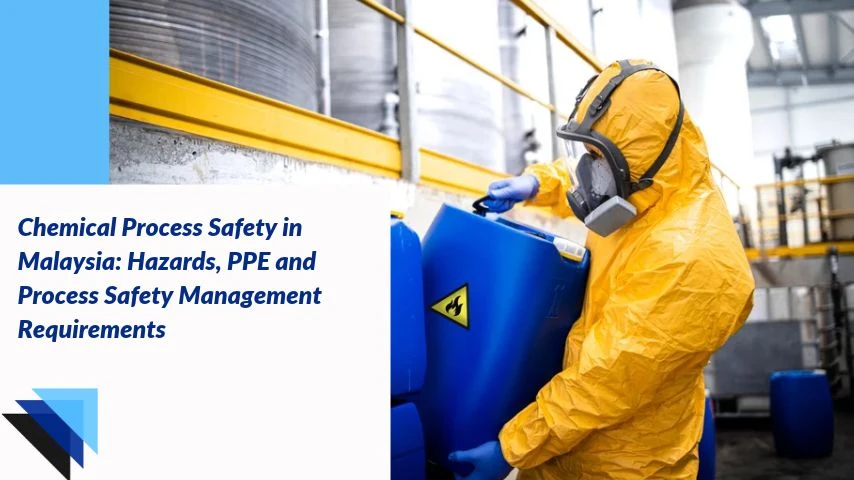
The PPE required for chemical safety depends on the chemical and the task. It is chosen from the hazard assessment and the safety data sheet, which lists recommended protection in its exposure controls section, and it is used after other controls, not instead of them.
How Is Chemical PPE Selected?
PPE is the last level of the hierarchy of controls, after elimination, substitution, engineering controls and administrative controls. USECHH reflects this in Regulations 15 and 16. Approved PPE is used where the application of other control measures would be impracticable, as an interim measure while preferred controls are installed, or where those measures do not adequately control exposure. The employer must also set procedures for issuing, maintaining, inspecting and training in the use of PPE, and the PPE must be suitable for the work, fit the employee, not adversely affect the employee’s health and be readily available. The selection starts with the chemical, its form (gas, liquid, dust), the route of exposure and the duration of the task. Glove and clothing materials must be matched to the specific chemical, because no single material resists all chemicals. Respiratory protection is selected based on the contaminant, its concentration, oxygen availability and the task conditions, with fit testing and user seal checks where applicable. PPE that is damaged, contaminated or poorly fitted gives a false sense of protection. DOSH publishes Guidelines on the Use of Personal Protective Equipment against Chemicals Hazards (2005), which guide employers on the PPE duties under the USECHH Regulations.
What PPE Is Commonly Used for Chemical Hazards?
Commonly used chemical PPE includes:
- Eye and face protection: chemical splash goggles, with a face shield where splashing is likely.
- Hand protection: chemical-resistant gloves matched to the chemical.
- Body protection: chemical-resistant coveralls, aprons or suits, depending on the exposure.
- Respiratory protection: respirators selected based on the contaminant, concentration, oxygen availability and task conditions, with fit testing and user seal checks where applicable, and used where exposure cannot be controlled by other means.
- Foot protection: chemical-resistant safety footwear.
Emergency eyewash stations and safety showers are not PPE, but they should be readily accessible near any area where corrosive or harmful liquids are handled.
How Can Wellkinetics Help
Wellkinetics supports organizations in Malaysia and globally in building and reviewing process safety management programs:
1. PSM Program Roll-Out: Consultation and implementation support for the roll-out of a Process Safety Management program.
2. PSM Audit and Health Check: Audit and health check of an existing PSM program, a specific process safety element or a procedure.
3. PSM Enhancement Proposals: Enhancement proposals for an existing PSM program, a specific process safety element or a procedure.
4. PSM Training: Training sessions that build staff competency to deliver an effective PSM program.
5. Process Safety Sessions: Facilitation of specific process safety sessions for operational or project purposes, such as HAZOP workshops and accident investigation.
6. Process Safety Workscope: Delivery of specific process safety work, such as CIMAH Reports for applicable installations.
Learn more about our process safety management consultancy services.
References
- Government of Malaysia. Occupational Safety and Health Act 1994 (Act 514). Putrajaya: Department of Occupational Safety and Health Malaysia.
- Department of Occupational Safety and Health Malaysia. Occupational Safety and Health (Use and Standards of Exposure of Chemicals Hazardous to Health) Regulations 2000 [P.U. (A) 131/2000] (USECHH Regulations). Putrajaya: DOSH. Available at: https://dosh.gov.my/wp-content/uploads/2026/04/Occupational-Safety-and-Health-Use-and-Standards-of-Exposure-of-Chemicals-Hazardous-to-Health-Regulations-2000.pdf. See also the DOSH reference page for the associated guidelines on chemical health risk assessment, chemical registers and personal protective equipment against chemical hazards: https://intranet.dosh.gov.my/chemical-management-v/usechh-regulation
- Department of Occupational Safety and Health Malaysia. Occupational Safety and Health (Classification, Labelling and Safety Data Sheet of Hazardous Chemicals) Regulations 2013 (CLASS Regulations). Putrajaya: DOSH. Available at: https://intranet.dosh.gov.my/chemical-management-v/class-regulations
- Department of Occupational Safety and Health Malaysia. Occupational Safety and Health (Control of Industrial Major Accident Hazards) Regulations 1996 [P.U. (A) 39/1996]. Putrajaya: DOSH. Available at: https://dosh.gov.my/wp-content/uploads/2026/04/ve_pua39_1996-1.pdf
- United States Occupational Safety and Health Administration. Process Safety Management of Highly Hazardous Chemicals, 29 CFR 1910.119. Washington, DC: US Department of Labor. Available at: https://www.osha.gov/laws-regs/regulations/standardnumber/1910/1910.119
- United States Occupational Safety and Health Administration. Appendix A to 29 CFR 1910.119: List of Highly Hazardous Chemicals, Toxics and Reactives. Washington, DC: US Department of Labor. Available at: https://www.osha.gov/laws-regs/regulations/standardnumber/1910/1910.119AppA
- United States Occupational Safety and Health Administration. Hazard Communication, 29 CFR 1910.1200. Washington, DC: US Department of Labor.
- United Nations. Globally Harmonized System of Classification and Labelling of Chemicals (GHS). Geneva: United Nations Economic Commission for Europe.
- National Institute for Occupational Safety and Health. Hierarchy of Controls. Atlanta: US Centers for Disease Control and Prevention.
Further Reading
- DOSH Malaysia – www.dosh.gov.my
- OSHA Process Safety Management standard, 29 CFR 1910.119 – www.osha.gov
- Center for Chemical Process Safety – www.ccps.aiche.org