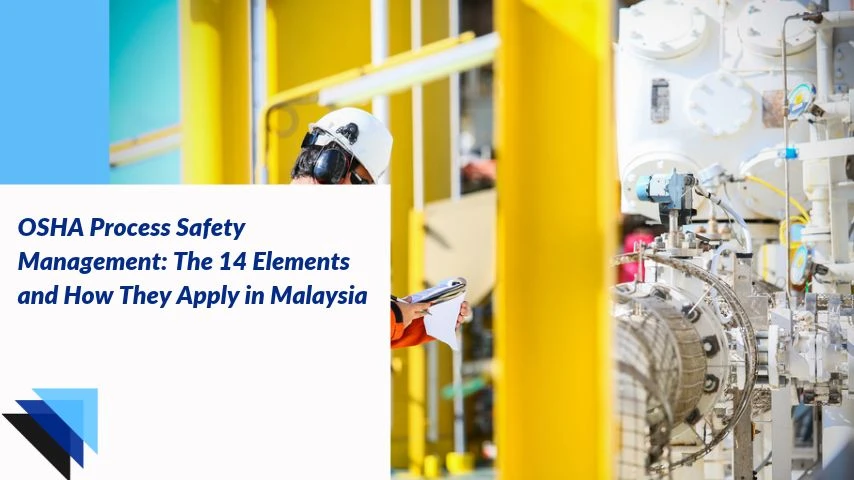
In Malaysia, process safety duties sit under the Occupational Safety and Health Act 1994 (OSHA 1994, Act 514), which is enforced by the Department of Occupational Safety and Health (DOSH). The Act imposes general safety and health duties, and regulations made under it address chemicals and major accident hazards, including the Use and Standards of Exposure of Chemicals Hazardous to Health (USECHH) Regulations 2000 and the Control of Industrial Major Accident Hazards (CIMAH) Regulations 1996.
This guide explains what Malaysian law requires, what the OSHA process safety management standard covers, how the 14 elements compare with the CIMAH Regulations, and how facilities in Malaysia apply the two together.
Understand Your Process Safety Requirements
Discuss how Malaysian process safety obligations and a structured PSM programme apply to your facility.
- What Does Malaysian Law Require for Process Safety?
- What Is OSHA Process Safety Management?
- What Are the 14 Elements of OSHA Process Safety Management?
- How Do the 14 Elements Compare With the CIMAH Regulations?
- How Do Facilities Apply OSHA Process Safety Management Alongside Malaysian Law?
- How Can Wellkinetics Help
- References
What Does Malaysian Law Require for Process Safety?
Malaysian law includes general safety and health duties under OSHA 1994, chemical health risk assessment under USECHH, and a Report on Industrial Activity under CIMAH for major hazard installations. It does not contain an element-based process safety management standard.
What Does the Occupational Safety and Health Act 1994 Require?
OSHA 1994 is the framework Act. It imposes general safety and health duties on employers, employees and others, and it allows regulations to be made under it for specific hazards. DOSH enforces the Act and its regulations. The Act does not itself set out the 14 elements of OSHA process safety management.
What Do USECHH and CIMAH Add?
USECHH addresses chemicals hazardous to health and includes chemical health risk assessment. The CIMAH Regulations 1996 apply to industrial activities that involve hazardous substances. A manufacturer must notify the industrial activity, and for a major hazard installation must consult a Competent Person, appointed by the manufacturer and approved in writing by the Director General, to prepare a written Report on Industrial Activity, also known as a CIMAH Report. The report must be updated within three years of the last report where the activity continues, under Regulation 16, and the regulations also require an on-site emergency plan.
Where Does a 14-Element Standard Fit?
A 14-element standard fits as a reference model that sits beside these duties. It does not replace them and is not a Malaysian legal requirement in itself. A facility meets its Malaysian obligations first, then uses the 14 elements to organise the internal program that supports them.
What Is OSHA Process Safety Management?
OSHA Process Safety Management is a management system standard for processes involving highly hazardous chemicals, and its purpose is to prevent catastrophic releases of toxic, reactive, flammable or explosive materials. The name comes from the United States Occupational Safety and Health Administration, and it is unrelated to OSHA 1994 as a statute.
What Does the OSHA Process Safety Management Standard Cover?
The OSHA process safety management standard covers a process involving a listed chemical at or above its Appendix A threshold quantity. It also covers a process involving a Category 1 flammable gas or a flammable liquid with a flashpoint below 37.8°C, on site in one location, in a quantity of 10,000 pounds (4,535.9 kg) or more. A process can include interconnected vessels, and separate vessels located so that a highly hazardous chemical could be involved in a potential release. The flammable coverage excludes certain hydrocarbon fuels used solely for workplace consumption and certain flammable liquids stored in atmospheric tanks or transferred while kept below their normal boiling point without chilling or refrigeration. The standard also excludes retail facilities, oil and gas well drilling or servicing operations, and normally unoccupied remote facilities. A facility should confirm coverage against the current text of 29 CFR 1910.119 and its Appendix A.
ALSO READ: The Importance of Process Safety in Handling Hazardous Substances
Why Do Malaysian Facilities Reference a US Standard?
Malaysian facilities may reference the US standard because it gives a recognised structure for a process safety program, and because a parent company, a client or a project standard may require it. In each case the adoption is a company or contractual decision. Where adopted, the standard works as an internal benchmark, not as Malaysian law.
ALSO READ: Process Safety vs Occupational Safety: Key Differences and Malaysia’s Safety Regulations
What Are the 14 Elements of OSHA Process Safety Management?
The 14 elements of OSHA Process Safety Management are employee participation, process safety information, process hazard analysis, operating procedures, training, contractors, pre-startup safety review, mechanical integrity, hot work permit, management of change, incident investigation, emergency planning and response, compliance audits, and trade secrets.
Which Elements Define the Process and Its Hazards?
Process safety information requires written information on the hazards of the chemicals, the process technology and the equipment, compiled before a hazard analysis is carried out.
Process hazard analysis is the systematic identification and evaluation of hazards, using a recognised method such as HAZOP, What-If or a checklist. Findings must be addressed, and the analysis must be revalidated at least every five years.
Operating procedures give written instructions for each operating phase, including startup, normal operation, shutdown and emergency operations, and must be certified as current each year.
ALSO READ: Understanding Process Hazards and How to Effectively Address Them
Which Elements Involve People and Contractors?
Employee participation requires a written plan for consulting employees and giving them access to hazard analyses and other process safety information.
Training requires initial training on the process and its procedures, with refresher training at least every three years.
Contractors requires the employer to evaluate contractor safety performance, inform contractors of the hazards, and control their entry into covered process areas.
Which Elements Keep Equipment, Work and Change Under Control?
Mechanical integrity covers inspection, testing and maintenance of specified process equipment, including pressure vessels and storage tanks, piping systems, relief and vent systems, emergency shutdown systems, controls and pumps. Deficiencies outside acceptable limits must be corrected before further use, or in a safe and timely manner where necessary measures assure safe operation.
Hot work permit requires employers to issue a permit for hot work conducted on or near a covered process, showing that fire prevention measures are in place.
Pre-startup safety review confirms that new facilities, and modified facilities where the change affects process safety information, are ready before hazardous chemicals are introduced.
Management of change requires written procedures for changes, other than replacements in kind, to process chemicals, technology, equipment and procedures, and to facilities affecting a covered process. The procedures address the technical basis, safety and health impact, operating procedure modifications, duration and authorisation before implementation. Affected operating, maintenance and contract employees must be informed and trained before startup of the affected process, and relevant process safety information and procedures must be updated.
Which Elements Respond, Learn and Verify?
Incident investigation requires investigation of incidents that did or could have caused a catastrophic release, started within 48 hours, with findings and recommendations resolved and documented.
Emergency planning and response requires a plant-wide emergency action plan, including procedures for handling small releases. Employers may also be subject to the hazardous waste operations and emergency response provisions where applicable.
Compliance audits require the employer to certify at least every three years that compliance has been evaluated, and to respond to the findings.
Trade secrets requires that information needed for compliance is made available to the people who need it, even where the employer treats it as confidential.
Assess Your PSM Programme
Review your existing process safety arrangements against the 14 elements and identify areas that may need improvement.
How Do the 14 Elements Compare With the CIMAH Regulations?
The 14 elements and the CIMAH Regulations 1996 share several features, though they are built differently. The parallels below come from the regulation text.
What Parallels Exist Between the Two?
- Management system: Regulation 5(1)(c) requires the manufacturer to establish and maintain a good management system for controlling any major accident, as described in the report.
- Hazard and risk analysis: Schedule 6 requires the Report on Industrial Activity to include a risk assessment covering potential sources of a major accident and the measures to prevent, control or minimise its consequences. This resembles the purpose of process hazard analysis.
- Equipment and training: Schedule 6 requires information on arrangements to ensure that the means for safe operation are properly designed, constructed, tested, operated, inspected and maintained, and on training arrangements. These relate to mechanical integrity and training.
- Modification: Regulation 15 requires a further report before a modification that can materially affect the report particulars. This resembles management of change.
- Updating: Regulation 16 requires a further report within three years of the last report where the industrial activity continues. This is a distinct CIMAH reporting obligation and should not be treated as equivalent to the OSHA three-year compliance audit.
- Emergency plans: Regulations 18 and 19 require an on-site emergency plan, kept up to date. Regulation 21 requires the manufacturer to inform and assist the local or port authority, which may prepare an off-site emergency plan, and Regulation 22 requires the manufacturer to provide and update information to the relevant public.
Where Does the Comparison Stop?
The comparison stops at structure and scope. CIMAH combines substantive major accident prevention duties with notification, reporting, emergency planning and public information requirements. Its Part IV reporting regime is important, but it is not the whole regulation. For major hazard installations, Part IV requires a Report on Industrial Activity prepared with a Competent Person appointed by the manufacturer and approved in writing by the Director General, whereas the OSHA standard is organised around 14 operating elements. CIMAH applies through its own threshold quantities in Schedule 2 and any determination by the Director General under Regulation 7(2), and Regulation 23 requires notification of a major accident, which is not the same as an internal incident investigation program. It has no element that matches hot work permits or contractor management by name. A facility should treat the CIMAH report and the 14 elements as complementary, and should not assume that one demonstrates compliance with the other.
Need Support With CIMAH Reporting?
Discuss CIMAH reporting requirements and process safety support for installations where the regulations apply.
How Do Facilities Apply OSHA Process Safety Management Alongside Malaysian Law?
Facilities apply OSHA Process Safety Management alongside Malaysian law by meeting the legal duties first and mapping their existing procedures to the 14 elements to find gaps.
What Should a Facility Check Before Adopting the Standard?
A facility should check four points. First, which Malaysian instruments apply, including CIMAH and USECHH, so that local duties are met first. Second, whether the process falls under the scope of the US standard or only uses it as a benchmark. Third, how each of the 14 elements maps to existing procedures. Fourth, who owns each element, because a program with no named owners tends to remain a set of documents. The mapping exercise, sometimes called a gap review, is usually the most useful first step.
How Can Wellkinetics Help
Wellkinetics supports organizations in Malaysia and globally in building and reviewing process safety management programs:
1. PSM Program Roll-Out: Consultation and implementation support for the roll-out of a Process Safety Management program.
2. PSM Audit and Health Check: Audit and health check of an existing PSM program, a specific process safety element or a procedure.
3. PSM Enhancement Proposals: Enhancement proposals for an existing PSM program, a specific process safety element or a procedure.
4. PSM Fundamentals Training: Awareness training sessions that build staff understanding to deliver an effective PSM program.
5. Process Safety Deep Dives: Review of a specific process safety work process or procedure against industry best practice.
6. Process Safety Sessions: Facilitation of specific process safety sessions for operational or project purposes, such as HAZOP workshops and accident investigation.
7. Process Safety Workscope: Delivery of specific process safety work, such as CIMAH Reports for applicable installations.
Learn more about our process safety management consultancy services.
References
- Government of Malaysia. Occupational Safety and Health Act 1994 (Act 514). Putrajaya: Department of Occupational Safety and Health Malaysia.
- Department of Occupational Safety and Health Malaysia. Occupational Safety and Health (Use and Standards of Exposure of Chemicals Hazardous to Health) Regulations 2000. Putrajaya: DOSH.
- Department of Occupational Safety and Health Malaysia. Occupational Safety and Health (Control of Industrial Major Accident Hazards) Regulations 1996 [P.U. (A) 39/1996]. Putrajaya: DOSH. Available at: https://dosh.gov.my/wp-content/uploads/2026/04/ve_pua39_1996-1.pdf
- United States Occupational Safety and Health Administration. Process Safety Management of Highly Hazardous Chemicals, 29 CFR 1910.119. Washington, DC: US Department of Labor.
- United States Occupational Safety and Health Administration. Process Safety Management, OSHA Publication 3132. Washington, DC: US Department of Labor.
Further Reading
- DOSH Malaysia – www.dosh.gov.my
- OSHA Process Safety Management standard, 29 CFR 1910.119 – www.osha.gov
- Center for Chemical Process Safety – www.ccps.aiche.org