
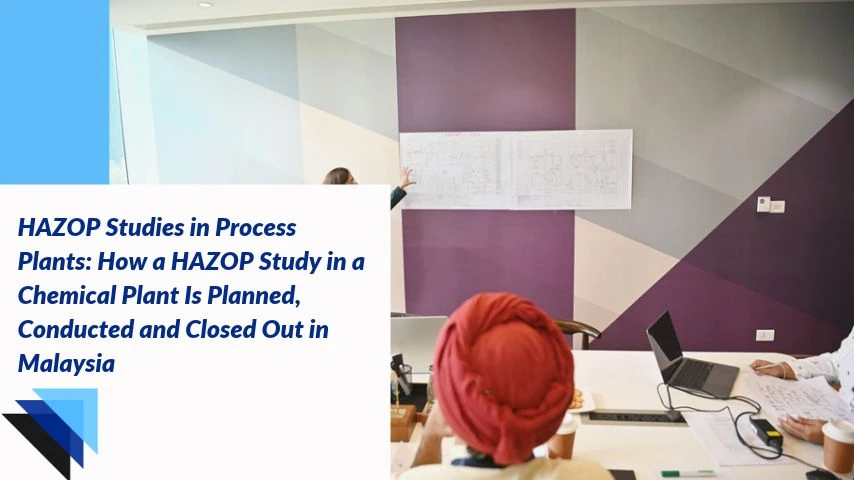
HAZOP studies in process plants are structured team reviews that examine a process design node by node, apply guide words to generate deviations from design intent, and evaluate the causes, consequences and safeguards of each deviation. A HAZOP study in a chemical plant converts a set of piping and instrumentation diagrams into a recorded set of hazard scenarios and recommended actions.
In Malaysia, HAZOP is commonly used in practice for process hazard analysis in chemical and related facilities. The method is not named as a mandatory technique in the Occupational Safety and Health Act 1994, which imposes general safety and health duties, or in the USECHH Regulations 2000, which focus on chemicals hazardous to health. The CIMAH Regulations 1996 apply to industrial activities that meet specified criteria and require a Report on Industrial Activity (also known as a CIMAH Report) for major hazard installations. A HAZOP study may be one of several inputs to the hazard identification and risk analysis supporting that report, but CIMAH does not name it as a required method.
This guide explains how a HAZOP study in a chemical plant is planned, conducted and closed out, and what separates HAZOP studies in process plants that change the plant from those that only produce a report.
Plan Your Next HAZOP Study
Get support planning and facilitating a HAZOP study for your chemical or process plant.
What Are HAZOP Studies in Process Plants?
HAZOP studies in process plants are facilitated, team-based examinations of a process design that identify hazards and operability problems by systematically applying guide words to each part of the process.
What Does a HAZOP Study in a Chemical Plant Examine?
A HAZOP study in a chemical plant examines each node against its design intent. A node is a defined section of the process, such as a reactor feed line or a distillation column overhead system. For each node, the team applies guide words such as No/Not, More, Less, Reverse and Other Than, together with applicable time-related guide words such as Early, Late, Before and After, to parameters such as flow, temperature, pressure and level. The team then records credible deviations, their causes, consequences, existing safeguards and any actions needed.
The “operability” element matters as much as the “hazard” element. The study also captures problems that create no immediate danger but prevent the plant from running as designed. IEC 61882 sets out the study procedure that this node-by-node, guide-word approach follows.
Why Do Malaysian Process Plants Conduct HAZOP Studies?
Malaysian process plants conduct HAZOP studies because the method gives a recorded, systematic basis for hazard identification on processes that handle hazardous chemicals. No single Malaysian instrument names HAZOP as the required method. The OSHA 1994 imposes general safety and health duties, while USECHH addresses chemicals hazardous to health, including chemical health risk assessment. Many plants adopt HAZOP through corporate process safety management programs and project standards. The study record also gives management and regulators evidence that hazards were examined methodically rather than from memory.
RELATED: Understanding the Importance of HAZOP Analysis in Ensuring Safety
How Is a HAZOP Study in a Chemical Plant Planned?
Planning fixes the scope, reference documents, node list, team and schedule before the first session, because sessions that start with incomplete information lose time clarifying design intent instead of analysing deviations.
What Documents Need to Be Ready Before a HAZOP Study?
A HAZOP study in a chemical plant typically draws on current piping and instrumentation diagrams (P&IDs), process flow diagrams, cause and effect charts, relief system data, operating procedures, safety data sheets and prior incident or near-miss records. For a revalidation, the previous HAZOP report is also needed. The P&IDs form the backbone of the study, so they must reflect the plant as built. A study conducted on outdated drawings can produce a clean-looking record of a plant that no longer exists.
How Are Nodes Defined and the Team Assembled?
The facilitator divides the P&IDs into nodes before the study starts, balancing node size against session time. Nodes that are too large hide scenarios, and nodes that are too small slow the study without adding insight.
A typical team includes an independent facilitator, a scribe, a process or design engineer, an operations representative and an instrumentation or control specialist. Maintenance, electrical or relief system specialists join for the nodes where their knowledge matters. The operations representative is essential because design intent and daily practice often diverge, and designers alone tend to miss deviations that operators recognise from experience.
When Is a HAZOP Study Scheduled in a Plant’s Lifecycle?
For a new plant, a HAZOP study is scheduled at detailed design, once the P&IDs are stable enough to review in depth but before major equipment procurement or construction makes design changes significantly more costly. It commonly follows an earlier, broader hazard identification screening. For an existing plant, a HAZOP study is repeated after significant modifications, which management of change should trigger, and periodically as a revalidation. The revalidation interval is a matter of company policy and good practice rather than a fixed period set by a Malaysian regulation, unless a specific regulatory approval, licence condition or corporate process safety standard imposes a defined interval.
RELATED: HAZOP in Oil and Gas Industry: How to Prepare, Conduct, and Improve Safety in Malaysia
How Is a HAZOP Study in a Chemical Plant Conducted in Session?
In session, the facilitator controls method and pace, the scribe records each deviation, and the team decides for every deviation whether it is credible and whether existing safeguards are adequate.
How Does the Team Work Through a Node?
The facilitator states the design intent of the node, then the team takes one parameter at a time and applies each relevant guide word. Each resulting deviation is tested with the same questions: what could cause it, what would happen if it occurred with no safeguards, what safeguards exist, and whether those safeguards are enough.
Consider “More Pressure” on a reactor running an exothermic reaction. A loss of cooling could be the cause. Without safeguards, the consequence could be a runaway reaction and vessel overpressure. The team lists the high-temperature trip and the pressure relief valve as safeguards, then considers whether each is effective, independent, auditable and capable of preventing or mitigating the scenario. If the answer is uncertain, the team records an action for follow-up. The same worksheet logic repeats for every deviation, and the team records a conclusion even when no action is needed.
What Makes a HAZOP Session Effective?
An effective session depends on facilitation skill more than on any other single factor. As a matter of good practice, the facilitator keeps the team on systematic deviation analysis, records a design question as an action instead of redesigning in the room, and keeps the discussion on the process rather than on individuals. Displaying the worksheet live lets the whole team confirm what is being recorded.
Pace matters in both directions. A session that moves too quickly under-identifies scenarios that are hard to imagine, while sessions that run too long reduce attention. Many teams schedule sessions in manageable blocks and rotate specialists in for the nodes that need them.
How Are Risks Ranked and When Is LOPA Used?
A conventional HAZOP study identifies and documents scenarios and safeguards; it does not itself calculate scenario risk. Many plants attach severity and likelihood ratings from a corporate risk matrix during or after the session so that actions can be prioritised. For scenarios with higher consequences, a plant can follow the HAZOP with Layer of Protection Analysis (LOPA), a semi-quantitative method that tests whether the independent protection layers reduce the risk to a tolerable level. LOPA is a separate step that uses HAZOP scenarios as its starting point and is normally applied selectively to scenarios where the consequence, complexity or risk ranking justifies more detailed analysis.
Need Further Risk Analysis?
Explore LOPA to evaluate whether independent protection layers provide sufficient risk reduction for selected HAZOP scenarios.
How Is a HAZOP Study in a Chemical Plant Closed Out?
Close out means the study is documented in a report, every recommendation has an owner and a due date, and each action is verified as complete or formally rejected with a recorded reason.
What Does a HAZOP Study Report Contain?
A HAZOP study report records the scope, the P&ID revisions used, the team and session dates, the node descriptions, the full worksheets and the recommendation list. It also records any items parked for later resolution. The report serves as the documented record of the study and becomes the reference for recommendation closure and for the next revalidation.
How Are Recommendations Tracked to Closure?
Recommendations are tracked in a register that records the action, the owner, the due date and the status. Closure needs evidence, such as a revised drawing, an installed instrument or an updated procedure, rather than a status change alone. If management decides not to implement a recommendation, the register records the reasoning and the approval so the decision can be audited later.
The most common failure at this stage is an action list that stays open for long periods. Regular management review of open actions, with priority given to those linked to higher-consequence scenarios, helps prevent a completed study from leaving the plant unchanged.
How Does Close Out Connect to Management of Change and Pre-Startup Safety Review?
Recommendations that alter the plant, such as a new trip or a revised relief arrangement, should pass through management of change so that drawings, procedures and training are updated together. For new or modified plant, a pre-startup safety review then confirms that the HAZOP actions required before startup are complete. Both elements belong to process safety management good practice and are not named under USECHH. They may also be relevant through corporate process safety systems, contractual requirements, or the commitments made in a Report on Industrial Activity for an applicable installation. Used together, they make the HAZOP study a working part of plant control rather than a stand-alone document.
What Challenges Affect HAZOP Studies in Process Plants?
The challenges most often cited in practice are weak inputs, compressed schedules, unbalanced teams and unclosed actions, all of which can reduce HAZOP studies in process plants to paperwork.
What Weaknesses Appear Most Often in Practice?
Common weaknesses include outdated P&IDs, schedules compressed to meet project dates, teams made up only of designers, and sessions that skip abnormal modes. Startup, shutdown and maintenance often introduce different operating conditions and should be reviewed deliberately. The guide-word method also examines one deviation at a time, so scenarios that arise from several simultaneous deviations need deliberate attention from the facilitator or a complementary method. Time and personnel cost is a further consideration, since a multi-session study takes experienced engineers and operators away from their normal duties.
How Do Plants Keep a HAZOP Study Current?
Plants keep a HAZOP study current by revisiting it when management of change shows a significant modification, when an incident or near-miss reveals a scenario the study missed, and on a periodic revalidation cycle set by company policy or, for installations subject to CIMAH, by the update reporting requirement. For those installations, Regulation 16 of the CIMAH Regulations 1996 requires the manufacturer, where the industrial activity is continuing, to consult a Competent Person to make a further report within three years from the date of the last report, with particular regard to new technical knowledge that materially affects the safety particulars of the previous report and developments in the knowledge of hazard assessment. A HAZOP revalidation may form part of the technical work supporting that update. A revalidation normally starts from the previous worksheets and current P&IDs, so the team spends time on what has changed instead of repeating the whole study.
How Can Wellkinetics Help
Wellkinetics supports organizations in Malaysia and globally in planning, facilitating and closing out HAZOP studies:
1. HAZOP Facilitation: Facilitation of HAZOP workshops for operational or project purposes.
2. HAZOP Study Report Development: Preparation of HAZOP study reports that document the node-by-node analysis, team composition and recommendations.
3. LOPA and Complementary Studies: Facilitation of Layer of Protection Analysis for higher-consequence scenarios identified during a HAZOP study.
4. Process Safety Workscope: Delivery of specific process safety work, such as Reports on Industrial Activity (CIMAH Reports) for applicable installations.
5. HAZOP-related Training: HAZOP Participant Training and HAZOP Leader Training, which build competency in taking part in and leading HAZOP studies.
Learn more about our process safety management consulting services.
References
- International Electrotechnical Commission. IEC 61882:2016 Hazard and Operability Studies (HAZOP Studies) – Application Guide. Geneva: IEC.
- Center for Chemical Process Safety. Guidelines for Hazard Evaluation Procedures, 3rd Edition (2008). New York: American Institute of Chemical Engineers.
- Government of Malaysia. Occupational Safety and Health Act 1994 (Act 514). Putrajaya: Department of Occupational Safety and Health Malaysia.
- Department of Occupational Safety and Health Malaysia. Occupational Safety and Health (Use and Standards of Exposure of Chemicals Hazardous to Health) Regulations 2000. Putrajaya: DOSH.
- Department of Occupational Safety and Health Malaysia. Occupational Safety and Health (Control of Industrial Major Accident Hazards) Regulations 1996 [P.U. (A) 39/1996] (“CIMAH Regulations”), including Regulation 16 (Updating of report). Putrajaya: DOSH. Available at: https://dosh.gov.my/wp-content/uploads/2026/04/ve_pua39_1996-1.pdf
- Department of Occupational Safety and Health Malaysia. Guidance on Preparation and Updating of Report on Industrial Activity, 2nd Edition (2023). Putrajaya: DOSH. Available at: https://dosh.gov.my/en/3d-flip-book/guidance-on-preparation-and-updating-of-report-on-industrial-activity-2nd-edition-2023/
Further Reading
- IEC 61882 HAZOP Application Guide
- CCPS Guidelines for Hazard Evaluation Procedures – www.ccps.aiche.org
- DOSH Malaysia – www.dosh.gov.my